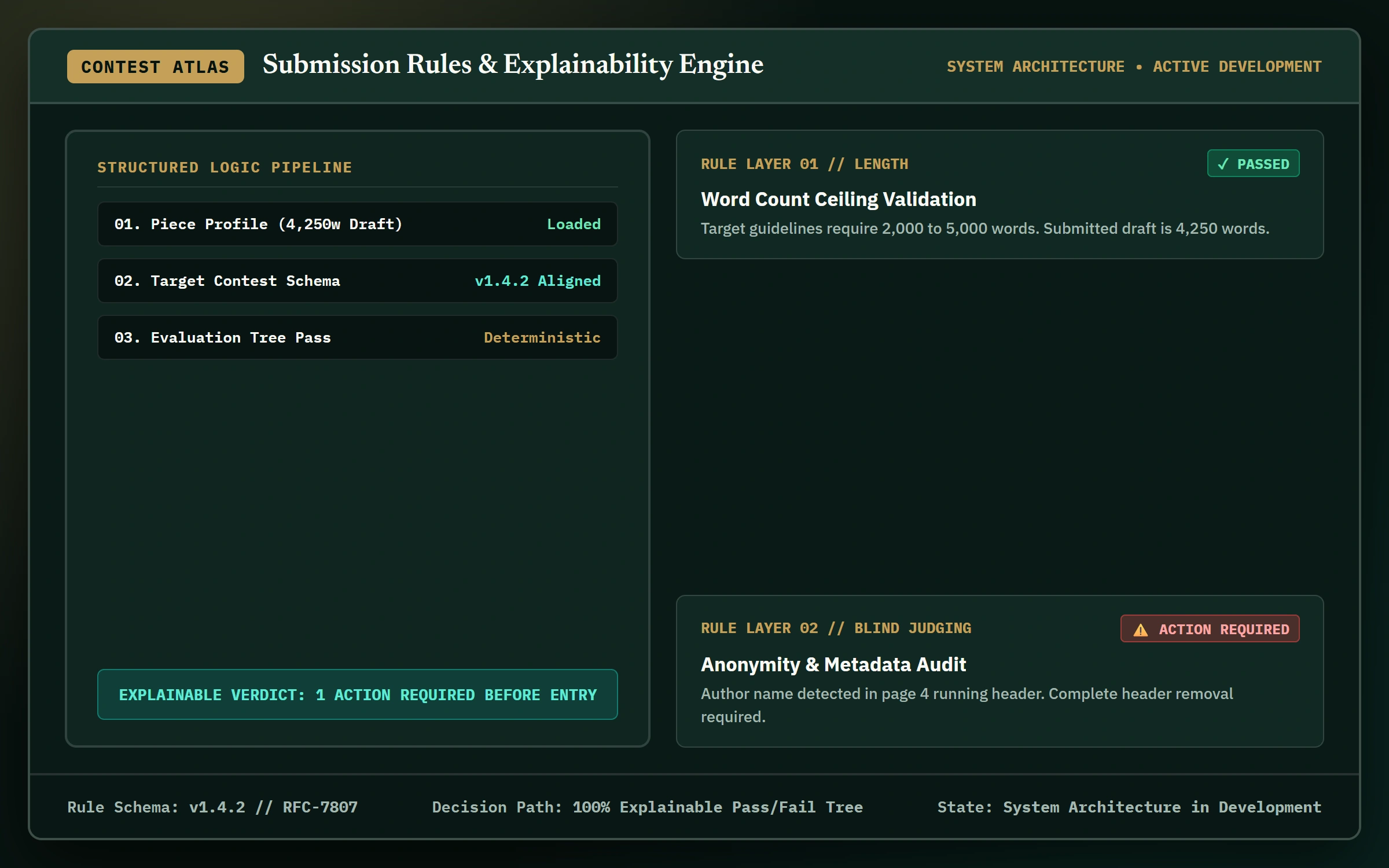
The Complexity of Submission Guidelines
Submitting literary manuscripts, fellowship applications, or grant proposals is notoriously error-prone. Guidelines are buried in PDFs or web pages with subtle, easily missed constraints:
- Hard Constraints: Word count limits (exact range vs. ceiling), blind judging requirements (zero identifying metadata anywhere in headers/footers), and prior publication clauses.
- Temporal Constraints: Timezone-dependent closing timestamps, rolling evaluation cycles, and simultaneous submission policies.
- Financial & Fee Logic: Multi-entry discounts, early-bird tiers, and fee waiver prerequisites.
"How do we represent human-written submission rules in a formal schema that can deterministically verify a manuscript before the author pays an entry fee?"
Deterministic Rule Schema Architecture
Contest Atlas breaks every opportunity into a standardized JSON rule definition containing three distinct evaluation layers:
Explainable Pass/Fail Tree
A core architectural requirement is 100% Explainability. When an author tests a manuscript against an opportunity, the system never returns a black-box percentage. It returns an audited breakdown:
Current Status & Future Milestones
Contest Atlas is in active core development:
- Phase 1 (Complete): Core rule schema specification and deterministic validation parser.
- Phase 2 (In Progress): Deadline countdown engine with timezone normalization and fee tier alerts.
- Phase 3 (Upcoming): Automated document sanitizer and local manuscript package exporter.